
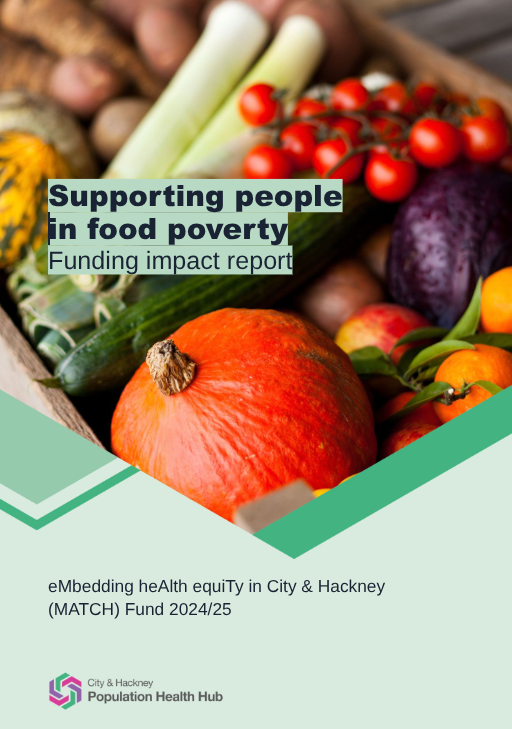
Supporting people in food poverty
How can we support people to get out of food poverty while also supporting their health and wellbeing needs?
Why is this important?
The numbers of people who are living in food poverty are rising, and this is a problem that is not affecting everyone equally. Children, disabled people, those from Black and mixed backgrounds and those without work are much more likely to experience food insecurity than other groups in the population. This mixed picture is reflected in the communities of City & Hackney.
Approach
Working with partners, the MATCH process led to the prioritisation of four change ideas:
- Projects that link residents and community food providers with guidance, training and support on nutrition, health and wellbeing.
- Projects delivering cooking classes to youth clubs.
- Projects that gather evidence and research that supports increased insight into food poverty and/or food pantry models in Hackney.
- Projects that build business models for sustainable food redistribution.
Making the change
The projects were delivered by three equity-led organisations: H.O.P.E at Morningside, Bloom Market, and Chatsworth Youth Club. They successfully piloted models that transitioned away from traditional, potentially unsustainable models such as foodbanks toward income-generating food provision underpinned by:
- Access and Sustainability
- Waste Reduction
- Health and Wellbeing
- Social Connection
Funded projects
Read the impact report:
Chatsworth Youth Club ‘Skills for Life’: 40 weeks of cooking classes for young people and their families.

‘BLOOM Market’: Sourced high quality surplus food directly from growers and local markets to create an affordable weekly veg box on a sliding price scale.

H.O.P.E. at Morningside Food Pantry: Established a sustainable, affordable, culturally appropriate food pantry to reduce reliance on the foodbank.
